
Disclosure Day ★★1/2

Availability: Showing widely in theaters internationally. Distributed by Universal, it is expected to stream as early as mid-July on multiple platforms. See JustWatch here for all current rental and purchase options.
Disclosing Spielberg’s Ego
Our aging film directors have taken to self-retrospectives. Francis Ford Coppola made a big splash, if not a particularly elegant or coherent one, with “Megalopolis” (2024). Paul Schrader, of “Taxi Driver” fame, did better with his complex, mature, and enigmatic “Oh, Canada” (2025), about an aging film director seeking absolution while dealing with the indignities of old age. Steven Spielberg plumbed his childhood and his early film-making obsession in “The Fabelmans” (2022) and is back for a second bite at the apple of narcissism with “Disclosure Day,” a long, greatest-hits anthology that recycles themes and genres dear to the director: “good” aliens that we should “listen” to (“E.T. The Extra-Terrestrial,” 1982, “Close Encounters of the Third Kind,” 1977); the Holocaust (“Schindler’s List,” 1993); high adventure (“Raiders of the Lost Ark,” 1981 and sequels); and, featured here, ideas of conspiracy (“E.T,” “Close Encounters,” “The Post,” 2017).
Spielberg is back for a second bite at the apple of narcissism.
Two characters with optimal performances carry the film. Cerebral cybersecurity specialist Dr. Daniel Kellner (Josh O’Connor) has stolen files from the Wardex Corporation, a shadowy entity in league with the US government (ala SpaceX and Palantir, and the anodyne organization in last year’s “Bugonia”). Daniel is a proponent of the right to know, especially the content of files that show human-alien contact and the maltreatment of extra-terrestrials dating back to the 1947 Roswell, New Mexico incident (surprise!). His theft has been discovered by federal authorities (the “terrorist” label near and dear to the current administration’s heart). On the run with his weird religious/satanic black-haired, black-eyed girlfriend Jane (Eve Hewson), he’s ready for the opportunity to make decades of secret films and videos public on the “Disclosure Day.” Kellner’s counterpart is blonde, wide-eyed Kansas City TV station meteorologist Margaret Fairchild (Emily Blunt), who begins speaking in tongues during her weather report. Margaret’s partner Jackson (Wyatt Russell) is a sweet but dull guy whose main function in the plot is to doubt Margaret’s growing self-awareness.

Emily Blunt as Margaret Fairchild finds she can interpret
more than the weather in Kansas City.
Dipping into the formational importance of childhood, the narrative reveals that, as 10-year-olds, both Daniel and Margaret had been invested by the aliens with extraordinary powers: Margaret with the ability to speak the alien language, based in mathematics, though without understanding it, and beyond that the facility to channel anyone’s past, psyche, friends, and enemies, a talent that will prove handy later. Daniel is endowed with the mathematical skills necessary to understand Margaret’s alien-speech. Together, they’re empathetic translators and communicators, qualities celebrated in “Arrival” (2016) and this year’s “Project Hail Mary.”

Colin Firth plays the film's chief enemy Noah as an inconsistent "bad guy"—sometimes ineffectual, sometimes telepathic, sometimes driven, sometimes sitting down on the job.
Spielberg has never been much good at bad characters, and “Disclosure Day” is no exception. The bad guy burden is shouldered by Noah Scanlon (Colin Firth), an inconsistent character affiliated with Wardex. The worst Noah does is to use his telepathic powers (also bestowed via the aliens) to torture Jane into trying to kill Daniel. Otherwise, his badness consists of not wanting the alien materials disclosed for fear they will cause worldwide panic, a defensible position if not Daniel’s (or Spielberg’s). And in the end, he inexplicably sits down and gives up. Conversely, Hugo Wakefield (a waste of Colman Domingo) is a white-bread “good guy,” eager to assist Daniel from a distance, rather than somebody we’re likely to care about.
Despite an arc set up for romance, there’s no romantic connection, much as some film-goers will wish there were.
Consistent with Spielberg’s film-making history, romance is held at arm’s length. Neither of the obvious couples is romantically engaged in any significant way, and there’s a failure to integrate the other half of each couple into the narrative. Jane disappears through most of the film’s second half, and Jackson is barely in the movie. Daniel and Margaret at first pursue their goals on parallel tracks, then they communicate with each other without being with or knowing the other. More than half-way through, they finally meet up and experience some harrowing adventures together (Indiana Jones stuff), and they are a pair of sorts in the final scene. Despite an arc set up for romance, there’s no romantic connection, much as some film-goers will wish there were. Spielberg may have understood that making the two a couple would risk elevating the cloying factor, but there could be something else going on in the director’s psyche.
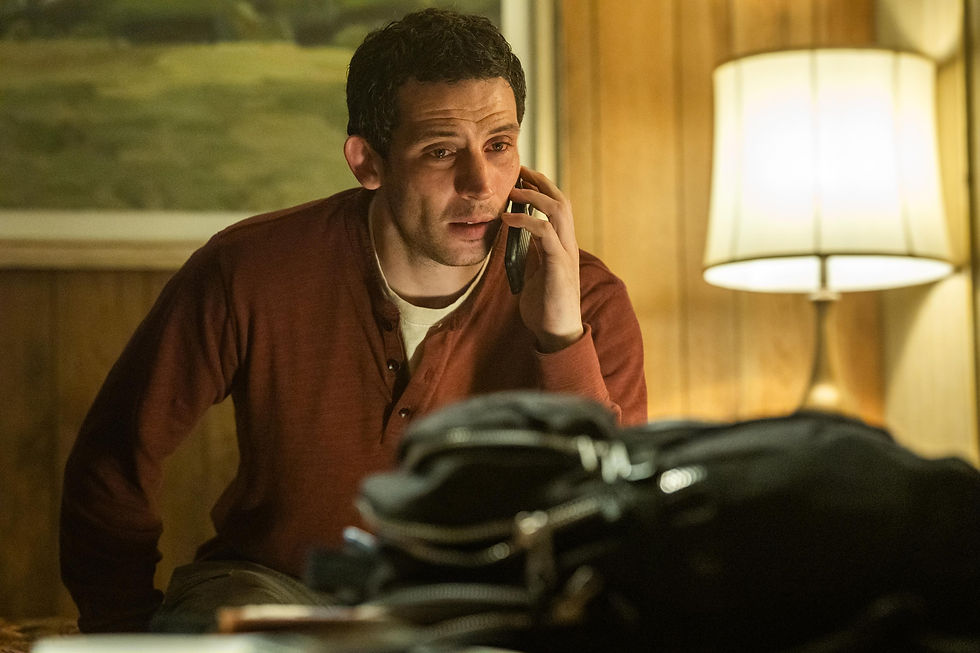
With his co-star Blunt, Josh O'Connor anchors the narrative. He's compelling as the scientist Daniel Kellner who believes in the public's "right to know."
The Holocaust is not treated explicitly in “Disclosure Day”; rather it is broached subliminally in a few early glimpses of the stolen files and the film’s final moments, as decades of abuse of, and experimentation on extra-terrestrials are “disclosed” through the mass media. These photos and videos—images of emaciated, corpse-like bodies—evoke the Muselmänner, the “living dead”/zombies of the concentration camps, some of them, like Spielberg’s extra-terrestrials, having been subjected to inhumane medical experimentation.
Although George Romero’s zombie trilogy is the best known filmic treatment of zombies and the Holocaust, “Poltergeist” (1982), based on Spielberg’s self-described “stream of consciousness” script, deals with violations of the rituals and customs surrounding death that were part of the Jewish experience of the Holocaust. “My life,” Spielberg revealed in 1993, “has always come back to images surrounding the Holocaust.” (Disclosure: one of 2 Film Critics has written of the relationship between zombie films and the Holocaust in Dapim: Studies on the Holocaust [2017], a journal published in Haifa, Israel; the essay also appeared in Hebrew.)
It’s not entirely unlikely that “Disclosure Day” is really about Jews and the Holocaust.
It’s not entirely unlikely, then, that “Disclosure Day” is really about Jews and the Holocaust and, consistent with that perspective, the cover-up and conspiracy it describes has more to do with denial of the Holocaust than with flying saucers. Though until the final scene, this and other “value drops” are so quick they barely hit one’s consciousness. Whatever the source of the conspiracy, the core of the film is the idea of a conspiracy—of information, of truths, withheld. Conspiracy has long been a film staple, with “Conspiracy Theory” (1997), starring Mel Gibson as a crazed, paranoid loner, exemplifying how Hollywood once presented the genre as a plot device not to be taken too seriously. Even “Bugonia,” with Jesse Plemons hilarious as the chief conspiracist, treats the subject as, let’s say, earnestly humorous.

In a scene reminiscent of Spielberg's "Indiana Jones" franchise, the weather forecaster Margaret (Blunt) and math genius/scientist Daniel (O'Connor) find themselves escaping by jumping from a moving car to a moving train—while chased by a bad guy.
Daniel Kellner is no crazed loner. His point that the public has a right to know is valid: the Pentagon Papers, My Lai, Iran-Contra, the global network of Epstein perpetrators. But with “Disclosure Day,” Spielberg has put his imprimatur on the centrality of conspiracy, and he has done so at a time when the threat to civic cohesion comes not from what has been covered up, but from right-wing obsessions that corrupt the trust that sustains government and democracy: Pizzagate (Hillary Clinton running a child-trafficking ring from the basement of a Washington, D.C. pizzeria); the Epstein Files (if they were only released, we would know the truth about Democrats); QAnon (the Deep State, a favorite of Trump); “Stop the Steal” (2020 election fraud); the Vaccination Hoax (Covid-19); and, as always, Extra-Terrestrial Aliens. One might add Holocaust Denial, which would provide a more serious grounding for the film.
The story too often depends on hand-held “magic bars," devices taken from the aliens that can do anything the script requires at the moment.
Spielberg can’t resist the chase and the narrow escape, and there are enough of both—on foot, in cars, on trains—to satisfy the most hardcore of adrenaline junkies and to give the movie that “high adventure” quality that is associated with so much of his work. As if these hi-jinks weren’t enough, the story too often depends on hand-held “magic bars” (for lack of a better term; they reminded us of Butterfingers), devices taken from the aliens that can do anything the script requires at the moment: kill, make our heroes invisible, create impenetrable glass shields, or transfer people telepathically. Daniel’s girlfriend Jane, having been absent from the screen so long we’ve forgotten about her, saves the day when she shows up with yet another magic bar, this one used to provide power to the Kansas City TV station that will do the disclosing.
For the most part, one willingly suspends disbelief to enjoy the thrill ride. Excellent performances by O’Connor and Blunt certainly help. But there is too much touching base here and there with Spielberg's past (the alien looks remarkably like a grown up E.T., albeit suffering from abuse) and too many over-the-top moments. In one case Spielberg asks too much, as we watch Daniel, in danger of being seen (and killed) at any moment by numerous agents of the coverup, skittering, hunched over, for hundreds of feet, behind a barely concealing fence. Not quite as embarrassing as George Clooney hunkering behind a Hawaiian bush in 2011’s “The Descendants,” but beneath the talents of one of our greatest filmmakers.
A disappointing effort.
He says: It’s not clear to me why Spielberg would turn from Emily Blunt to Courtney Grace (playing an unnamed NBC news anchor) in the powerful finale. Grace is excellent, but Blunt is the heart of the story and deserves that moment.
She says: On leaving the theater I said, “mildly entertaining.” In thinking about it more afterwards, it doesn’t hold up even to that.
Date: 2026
Director: Steven Spielberg
Starring: Emily Blunt, Josh O’Connor, Colin Firth, Eve Hewson, Colman Domingo, Wyatt Russell
Country: United States
Language: English, and some alien-speak
Runtime: 145 minutes
Other Awards: 1 win and 3 other trailer nominations


Comments