
Highest 2 Lowest ★★★

Availability: Opened in theaters nationally August 15 on a limited number of screens. Apple TV+ will stream it beginning September 5. Apple is doing the bare minimum (3 weeks in some theaters) to qualify the film for awards. Spike Lee should have demanded more. For full future online purchase and rental options, see JustWatch here.
Will He Do the Right Thing?
The incongruity begins with the opening sequence, as the lyrics from the 1943 musical, “Oklahoma!”—“There’s a bright, golden haze on the meadow”—ring out over soaring drone shots of skyscrapers, bridges, and rivers of a shimmering New York City. The iconic “Oh, What a Beautiful Mornin,’” sung by Broadway star Norm Lewis, is hardly the start one expects from Spike Lee’s latest, about a Black music business mogul living in a penthouse high above Brooklyn, enjoying spectacular views of Manhattan and the iconic Bridge. Only Lee could pull this off. Music, as the opening presages and the closing scene confirms, is so pervasive that his latest has some of the feel of a musical, an entertaining musical.
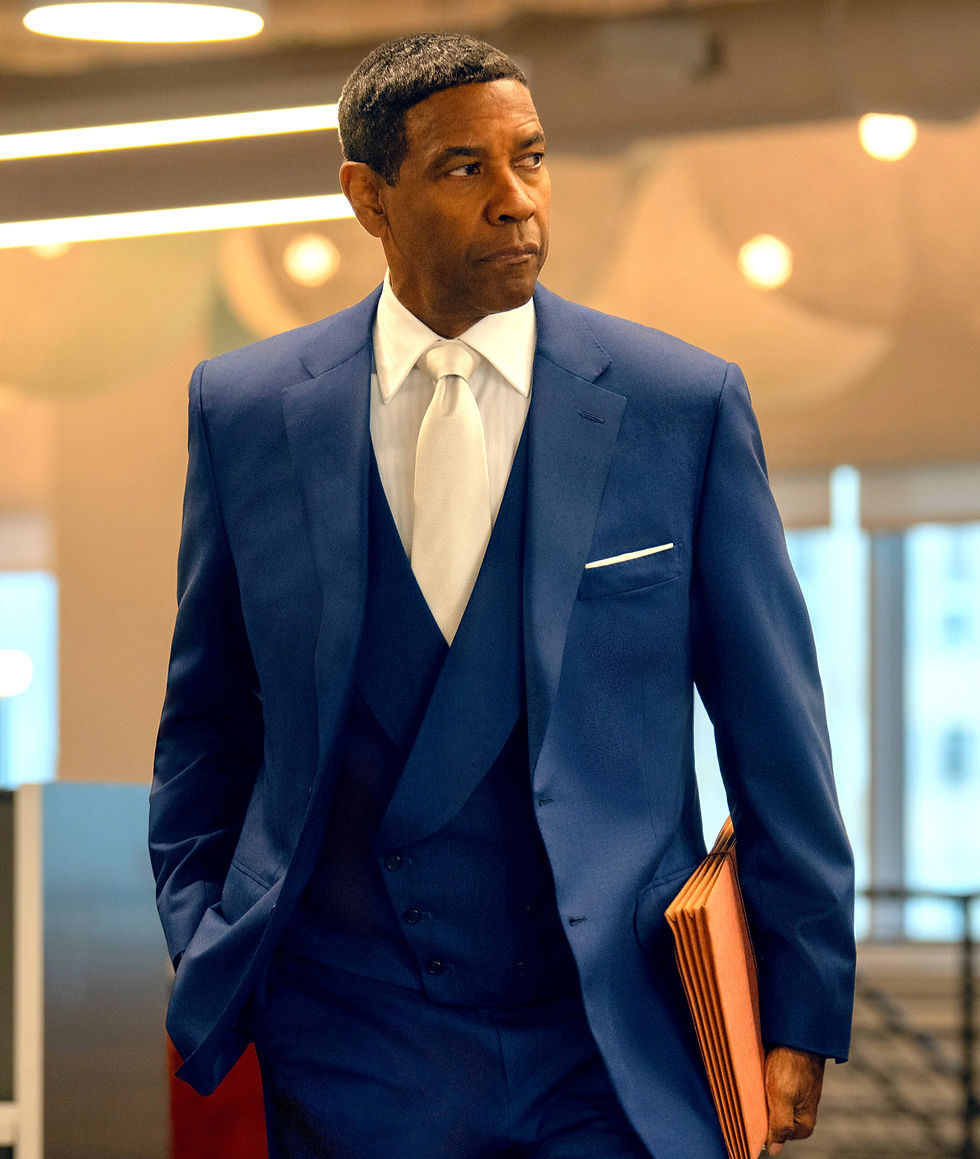
The record mogul David King (Denzel Washington) is all transactions,
even when there's a ransom due.
Transactional defines King, even when he thinks his only son has been kidnapped.
Denzel Washington is near-perfect as the dapper mogul, David King, who, at the close of that paeon to a mash-up of the Sooner State and the Big Apple, acknowledges “everything’s goin’ my way” by taking a critical step in the transaction that will allow him full control of his record company, Stackin’ Hits. Transactional defines King, even when he thinks his only son Trey (Aubrey Joseph) has been kidnapped for a $17.5 million ransom, and even more so when he learns his son is free and his chauffeur and good friend’s son has been kidnapped in a mix-up of the 2 teen friends.

David King (Washington) on the subway with the $17.5 million in Swiss francs in a backpack he sets down beside him (not even holding onto it!) on his way to deliver the ransom money.
King initially expresses no intention of paying the ransom for what he sees as a mistake by the kidnapper: the kidnapper blew his side of the transaction. A business partner, after failing to reach King with the moral argument, points out to him that letting the boy die will not be good for business. King’s son appears to have inherited the transactional gene, lamenting he won’t be accepted into a good college and his friends will trash him on social media if Dad doesn’t pay the ransom. King’s wife and Trey’s mother Pam (Ilfenesh Hadera) mourns the impending loss of her luxurious penthouse (including a gallery of notable Black artists) if the kidnapper has his way.
Lee seems only mildly interested in the obvious moral dilemma. King tells one of the cadre of police investigators set up at a dining room table under a Basquiat that he refuses to let the kidnapper believe he will pay the ransom, then a moment later walks into the room to tell them he will. We never see the deliberation leading to that change of mind (or heart, if that’s what it is).
Lee may have envisioned the ensuing pursuit by the inept police as a kind of “French Connection” (1971) escapade, but viewers will find the action more frustrating than thrilling.
The decision to “do the right thing” brings on the “thriller” part of this “crime-thriller.” The mogul himself (now taking on the familiar Washington determined-tough-guy role) hoists the backpack stuffed with $17.5 million in Swiss 1,000 franc notes and boards a subway full of Yankees fans, whose boisterous conduct is presumably designed to make the journey more unsettling and stressful. Follow the backpack. Lee may have envisioned the ensuing pursuit by the inept police as a kind of “French Connection” (1971) escapade, but viewers will find the action more frustrating than thrilling. It’s seen mostly from a car driven by a true jerk of a white cop (Dean Winters) through a Puerto Rican Day parade and festival, cross-cut with a 7-minute “Puerto Rico” song by revered Eddie Palmieri, on stage in the street with his band. (In homage to his 1989 “Do the Right Thing,” Rosie Perez is onstage too, as herself.) The scooter exchanges are almost comical.

Spike Lee, left, with rapper A$AP Rocky,
who brings dynamism and intensity,
not to mention style,
to the character Yung Felon.
As the “thrills” recede, the transactional milieu reemerges when the rapper Yung Felon enters the picture. Invested with desire and intensity by Manhattan rapper A$AP Rocky, Yung Felon is the only person in the film who can match King’s authority, dynamism, and obsession with personal success. And, yes, there are long rap sequences, in which Washington’s King participates, adding to the “musical” genre.
“Highest 2 Lowest” suffers from an Alan Fox script that lacks subtlety and, often, common sense.
Gorgeously filmed, well-acted by King and A$AP Rocky, “Highest 2 Lowest” suffers from an Alan Fox script that lacks subtlety and, often, common sense. Too many scenes don’t work well, or don’t work at all, whether it’s the authorities refusing to take King seriously when he tells them he knows the identity of the kidnapper (while insisting they need more information from the near-comatose victim), or King summarily announcing he’ll pay the ransom, or King dressing down his son in a manner that seems out of character, or the chase scene without the thrills, or the cloying finale, in which King unconvincingly deals with the personal and family dilemma that has come to dominate his life. There, and elsewhere, King is flanked by a bland wife and son, and by his best friend/chauffeur Paul, played by Jeffrey Wright (“American Fiction,” 2023) who, even though his own son’s life is at stake, does not have the gravitas to serve as an effective counterweight to King’s dollar-sign perspective.
Lee taps into his own milieu, probing personal anxieties about his legacy.
“Highest 2 Lowest” is based on the award-winning 1963 Akira Kurosawa “High and Low,” with the inimitable Toshiro Mifune as a wealthy shoe executive caught in a kidnapping dilemma. In his adaptation, Lee, who has directed more than 60 film and television productions, taps into his own milieu, probing personal anxieties about his legacy, about not making the films that are closest to his heart—agonizing over his Black entertainment business, as does his alter-ego King/Washington.
Because the agonizing here involves watching the concerns of the hyper-wealthy over their sales, shares, and luxury apartments, the film does not carry the ethical and emotional valence of Lee’s earlier works. “Do the Right Thing” struck a chord over issues of race and ethnicity and neighborhood—real conflict and differences between real people in a real place. “Highest 2 Lowest,” while entertaining, not only gets sidetracked into the “thriller,” long musical sequences, and the lives of the rich and famous, but most importantly fails to grapple adequately with the moral questions it poses.
She says: We kept waiting for the twist that would make it interesting. It never came.
He says: A failed effort to recuperate an arrogant, self-obsessed businessman—and by implication, Spike Lee.
Date: 2025
Director: Spike Lee
Starring: Denzel Washington, Jeffrey Wright, A$AP Rocky, Aubrey Joseph, Ilfenesh Hadera, Dean Winters
Runtime: 133 minutes
Country: United States
Language: English
Other Awards: none to date


Comments