
Sentimental Value (Affeksjonsverdi) ★★★

Availability: Showing widely in theaters; streaming through distributor Neon expected early to mid-2026 on multiple platforms. See JustWatch here for full and up-to-date online and other availability.
Of House and Home
It’s December, the month for “family” movies. “Sentimental Value” is no “It’s a Wonderful Life,” though both deal in suicide, feature mid-life (or late-life) crises, and patch things up in the end—or try to. Think twice about bringing the kids.
Director Joachim Trier’s latest, Norway’s submission for Best International Film Oscar, is a father-daughter film. The father, played with steely, self-absorbed reserve by Stellan Skarsgård, is film director Gustav Borg, “on a roll” as he puts it, at 70 or so, but he’s gone a decade without a new documentary or feature. Borg abandoned his family—a wife with whom he quarreled, and two daughters, Agnes (8 or so when he left) and Nora (then about 13)—and did not return until his wife’s death, 25 years later.

The gulf between father (Stellan Skarsgård) and daughter (Renate Reinsve)
seems unbridgeable in Norwegian Joachim Trier's "Sentimental Value."
The family that remained after their father’s departure is described vaguely, and metaphorically, in an opening scene in which Nora, in a school essay about an object, describes the large red-trimmed, dark brown wood-clad Victorian anthropomorphically, as a building with feelings, an unhappy place that wanted to be (but was not) full. The stove pipes between rooms are the house’s way of communicating the parents’ loud and ugly arguments to their daughters. (The opening shot from high above the city to the Victorian’s interior is reminiscent of the opening shot in the director’s award-winning “The Worst Person in the World” [2021].)
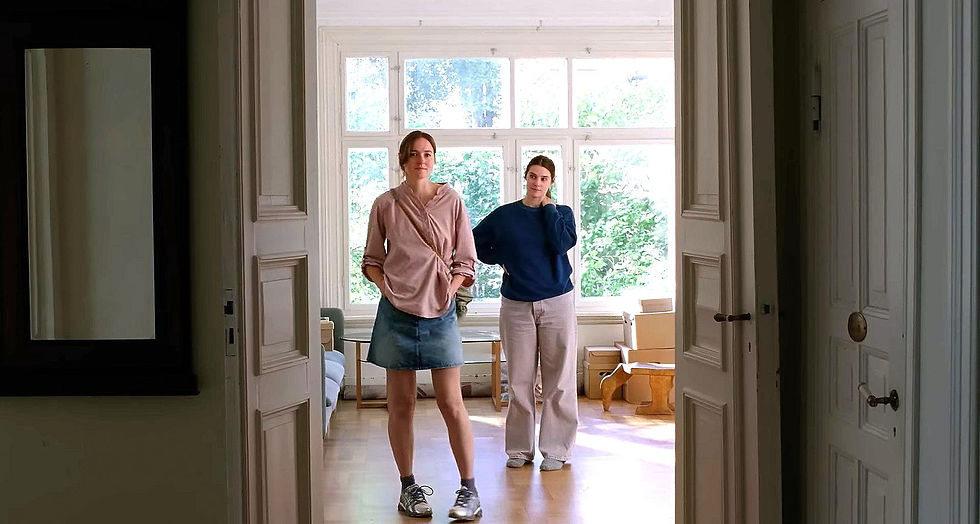
The daughters, Nora (Reinsve, left) and younger Agnes (Inga Ibsdotter Lilleaas)
deal with the puzzle that is their father
--who has the family home stripped of its memories and painted white.
The girls’ mother, a depressed psychologist, did not do much mothering; it was Nora who combed her younger sister’s (Inga Ibsdotter Lilleaas) hair and got her off to school. “You cared for me,” Agnes says, explaining how she emerged from childhood relatively unscathed, got married, and had a child. She made a home. We’re told that Gustav’s mother committed suicide in the brown and red house when he was 7. A loose-end of Nazi torture involving Gustav’s relatives makes it into the story too.
Reinsve is capable of great warmth and vibrancy; when those qualities are withheld, as they often are here, the result is a roiling interiority.
Nora (Renate Reinsve, best actress at Cannes for “The Worst Person in the World” and recently described in a Los Angeles Times “the Envelope” cover story as “perhaps the most exciting performer working today”) is the daughter half of the father-daughter paradigm at the center of the film. Reinsve is capable of great warmth and vibrancy; when those qualities are withheld, as they often are here, the result is a roiling interiority. In powerful and harrowing early scenes, the late-30s stage actress, while enjoying acting and reveling in the attention it brings, suffers from excruciating, nearly debilitating performance anxiety. Much later we learn that Nora once tried to kill herself.

Renate Reinsve (the daughter) and Skarsgård (the father) are outstanding, even if the Skarsgård character is viscerally unappealing—outwardly cool and inwardly calculating.
Whereas Agnes is willing to give her father grace and, to some extent, move on from the trauma of her childhood, Nora is unforgiving, summarily rejecting his rather tepid overtures. “We can’t communicate,” Nora tells him. “You don’t even know us.”
In what some will see as the epitome of arrogance, film director Gustav Borg thinks he and his daughter Nora are the same.
“Ay, there’s the rub,” to quote Hamlet. Gustav thinks he does know Nora, and not superficially. In what some will see as the epitome of arrogance, he thinks he and Nora are the same: victims of a difficult upbringing; brilliant, and in some way troubled, in their careers—one in mid-career crisis, the other in late-career crisis; neither with a home or a partner; Gustav, able, because of his mother’s death, to imagine (even if he was not present) Nora’s attempted suicide. He, too, was abandoned. Indeed, Gustav knows Nora well enough to write a screenplay, with a Nora-like character at its center, to be acted, he hopes, by her. After American screen star Rachel Kemp (Elle Fanning) confesses to feeling inadequate in the role, Nora agrees to do it.
As in recently-released “Hamnet,” “the play’s the thing,” even if it’s not, in this case, Shakespeare’s “Hamlet.” Filming doesn’t take place in the remodeled and repainted (a sterile white) house, but on a set. There’s a scene involving suicide.
Borg (and Trier) are playing with the idea of authenticity; what’s real (what actually happened in the Borg family?), and what is not (what elements are just part of the play)?
Borg (and Trier) are playing with the idea of authenticity; what’s real (what actually happened in the Borg family?), and what is not (what elements are just part of the play)? Do Nora and Gustav reconcile? And, if so, is that reconciliation credible? Is it reasonable to believe that a daughter, abandoned by her father for much of her life, would find him a kindred spirit? Could Gustav’s own experience, even if at times parallel to Nora’s, be sufficient to generate the deep empathy required for a renewed relationship?
“Sentimental Value” is a two-person show, even a two-hander. But a couple of the secondary characters stand out. Lilleass has perfect pitch as the younger, softer, and now the caretaker sister. Lars Väringer imbues Gustav’s longtime cinematographer, Peter, with the physical and emotional debilities of old age that we are meant to see in Gustav.
Reinsve and Skarsgård are outstanding, even if the Borg character is viscerally unappealing—outwardly cool and inwardly calculating. Trier and Eskil Vogt’s abstruse and intellectualized script, doling out hints of an argument in drips and drabs, in metaphor, and as part of a film-within-a-film, asks too much of the audience.
He says: Like the brown and red Victorian house it describes, the script has a fatal flaw.
She says: Loved the acting, but I’m tired of the film-within-a-film, of directors obsessed with their own profession.
Date: 2025
Director: Joachim Trier
Starring: Renate Reinsve, Stellan Skarsgård, Inga Ibsdotter Lilleaas, Elle Fanning, Lars Väringer
Country: Norway
Language: Norwegian (subtitled in English) and English
Runtime: 133 minutes
Other Awards: 10 wins (including a BAFTA and at Cannes, the Grand Prize of the Festival—the second biggest award) and 39 other nominations (with a 19-minute standing ovation at the Toronto International Film Festival).


The film asks too much of you two I guess.