
The President’s Cake (Mamlaket al-qasab) ★★★1/2

Availability: Still showing in select cities nationally and internationally. Distributed by SONY Pictures, now available on Amazon Prime Video, AppleTV, and Fandago at Home. See JustWatch here for full availability.
Rooster Girl
“The President’s Cake” might best be described as a “quest” film, but it’s nothing like Indiana Jones’ search for the Lost Ark of the Covenant, or even Dorothy’s journey to Oz to locate the Wizard and return to Kansas, though it shares some qualities with that 1939 epic. As in “The Wizard of Oz,” the protagonist of first-time director and writer Hasan Hadi’s story is a girl, in this case 9-year-old Lamia (Baneen Ahmad Nayyef), accompanied by Saeed (Sajad Mohamad Qasem), a boy of similar age, who journeys, as did Dorothy, from the country to the big, distant city—to find not the Holy Grail, but flour, sugar, eggs, and baking powder: the ingredients for (you guessed it) The President’s Cake. We imagined a happy ending to such a frivolous adventure and, well, you could take it that way. If you were an eternal optimist, or a sentimental fool.

Granddaughter Lamia (Baneen Ahmad Nayyef) and her grandmother
Bibi (Waheed Thabet Khreibat) wending their way around their village
in the southern Iraqi marshes.
The tale opens in the lusciously filmed marshes of southern Iraq, the “cradle of civilization,” formed by the convergence of the Tigris and Euphrates, where Lamia, her parents deceased, survives in poverty with her aged grandmother Bibi (Waheed Thabet Khreibat), living in a thatched hut. Gondola-like boats cruise the waterways; the sounds of traditional instruments—an oud, a flute—fill the air.
President Saddam Hussein is in full ego mode (though nothing rises to the level of our own egomaniac, Donald Trump) as his birthday approaches.
Saeed’s no better off than Lamia. Not only poor (to the point of thievery), but the son of a cripple, which earns him the scorn of classmates. It’s the 1990s, and President Saddam Hussein, despite the crushing economic sanctions imposed by the UN for Iraq’s invasion of Kuwait—and US bombing—is in full ego mode (though nothing rises to the level of our own egomaniac, Donald Trump) as his birthday approaches, his image ubiquitous, the populace required to celebrate the dictator at every opportunity.
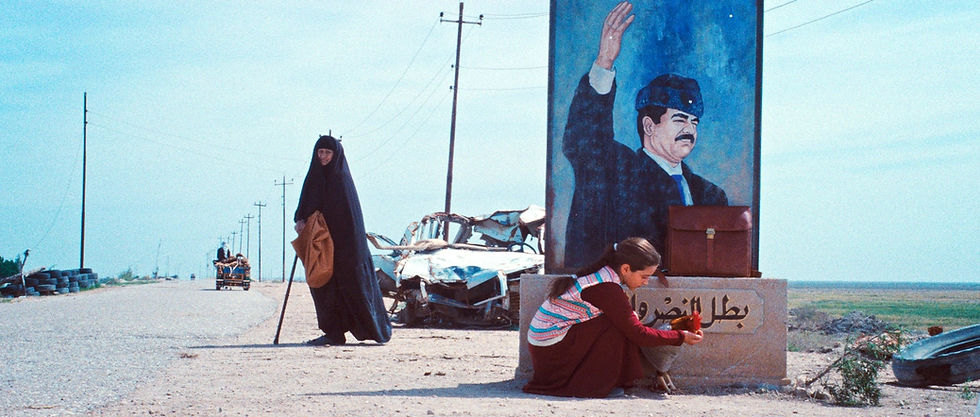
Bibi (Khreibat) and Lamia (Nayyef), with her rooster Hindi, wait for a ride into the city on a road celebrating Hussein and littered with wreckage—possibly from US bombs.
At the school Lamia and Saeed attend, their martinet teacher Mr. Musa (Ahmad Qasem Saywan) parrots instructions to his young charges that they must sacrifice for their leader. He presides over a lottery that assigns Saeed the task of locating fruit for the upcoming class celebration and Lamia of producing a cake commensurate with the overblown importance of the occasion. Hadi could be setting the stage for a comedy of the absurd, a light-hearted drama with political overtones, or even a musical. But this is deadly serious. The journey begins.
Like Dorothy and her companions, Lamia and Saeed soldier on, intrepid, penniless, country mice among city mice.
It’s not long before Lamia and Saeed are alone in the city—a development that allows the children to operate independently. At the same time, we follow a significant subplot featuring Bibi and a taxi driver/mailman/stranger (Rahim AlHaj, the only professional actor, a celebrated Iraqi oud master based in the US) who has given Bibi and Lamia a ride into town. Like Dorothy and her companions, Lamia and Saeed, separated from adult caretakers, soldier on, intrepid, penniless (with only her dead father’s old, maybe silver, maybe not, pocket watch to trade), country mice among city mice (Lamia has never seen an amusement park), naïve about the ways of the world beyond the village, bonded in 9-year-old fashion: “Are we a team now? asks Saeed, and Lamia breaks into a wide smile. They’re a team (until they’re not), both persistent and desperate to bring back a few pieces of fruit and the makings of a cake.

Saeed (Sajad Mohamad Qasem), left, and Lamia (Nayyef) on their quest for cake ingredients, encountering angry and sometimes duplicitous adults in the streets and souks.
Here the watch-store owner gives them cash for Lamia's dead father's watch, or does he?
The obstacles they encounter are those that children in an adult world might inevitably face, though with a political valence reflecting a social order under enormous stress, damaged by sanctions and an authoritarian regime. Everyone—except the taxi driver, and including Bibi—is angry: the teacher, a dealer in watches, a wholesaler of flour who can’t spare the little it would take to make that cake, the police. Even the kids get angry, their anxiety and frustration shattering (literally as well as figuratively) their fragile and poignant intimacy.
Everyone is angry.
Then there’s the obese store owner intent on having sex with a very pregnant woman who needs to offer her body to him in exchange for a few goods; the pedophile who ingratiatingly locates eggs and a jar of sugar before leading Lamia into the proverbial den of iniquity; and currency transactions beyond the comprehension of Lamia and Saeed—and the audience. Corruption—the corruption of petty capitalism driven to the extreme, of government officials inured to payoffs, of police who see no point in helping “peasants”—is everywhere.
The kids make the best of it, wresting moments of pleasure from their bleak circumstances and the pressure to produce for the President. At a café, a woman singer invites Lamia to sing and dance with her, and the earnest young girl smiles, in joy and gratitude. Lamia has brought Hindi, a vocal rooster, with her on the journey, as if holding on to the village she’s left behind and what remains of what’s good in her life. Yet tension remains. Saeed is jealous of her dancing, perhaps fearing the loss of whatever intimacy they’ve developed. And when Hindi escapes—from Saeed’s custody—it’s all Lamia can do to hold on to the friendship they have shared.
Iraq’s submission (Iraqi films are rare) as a “Best International Feature Film” for the 2026 Oscars and winner of the top prize in the Directors’ Fortnight section of the 2025 Cannes Film Festival, “The President’s Cake” gathers strength from the tension generated between 2 children caught up in a world that’s quite beyond their skills and understanding, and the possibility, the suggestion, that the trauma they experience comes from the top down, from an authoritarian regime that has damaged social institutions and eroded civility.
What could have been, and ought to have been, simple and enjoyable tasks—securing a few pieces of fruit and baking a cake—become instead the stuff of nightmares. Leaders matter. A superbly crafted and compelling piece of work.
He says: To borrow a phrase from 2nd-wave feminism, “the personal is political.”
She says: Both directly relevant to our current political situation, and wonderfully specific in portraying what I now know are the persecuted Shia minority in Iraq, whose marshes were drained by Hussein, since restored.
Date: 2025
Director: Hasan Hadi
Starring: Baneen Ahmad Nayyef, Sajad Mohamad Qasem, Waheed Thabet Khreibat, Rahim AlHaj
Country: Iraq
Language: Arabic, with Iraqi dialect, subtitled in English
Runtime: 105 minutes
Other Awards: 11 wins and 12 other nominations

Comments